
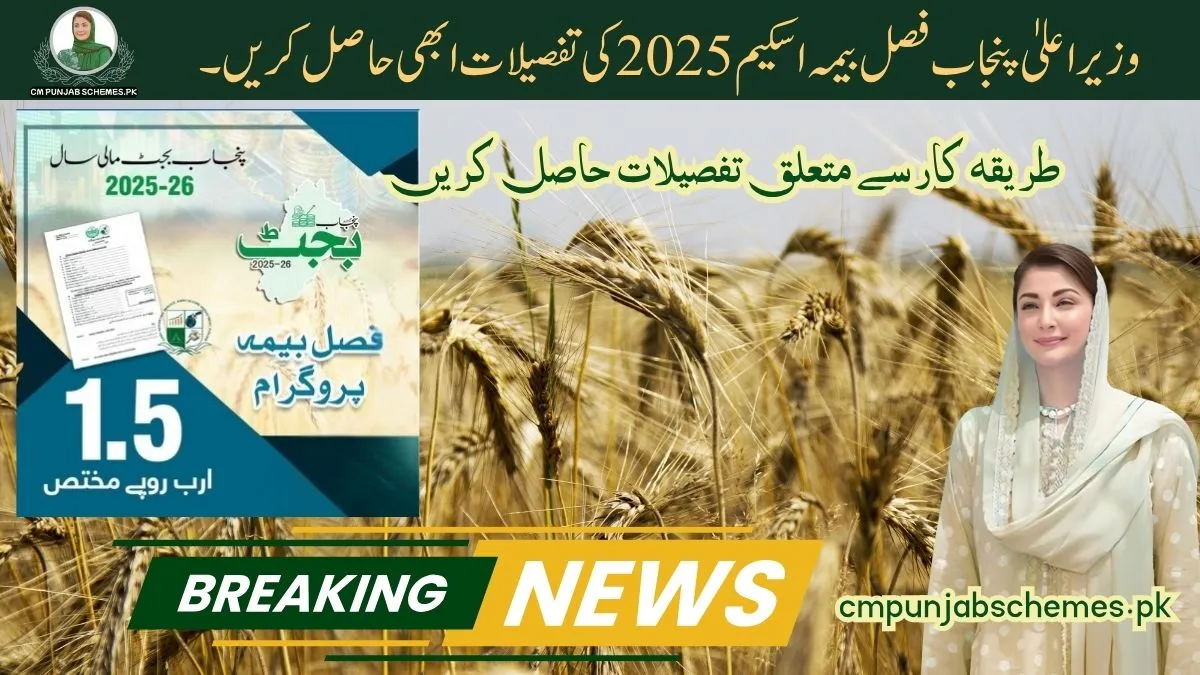
Imagine pouring your heart and life savings into a crop only to lose it all to flood, drought or pests. That despair is painfully real for many Punjab farmers. But in 2025, Chief Minister Maryam Nawaz Sharif introduced the Punjab Crop Insurance Scheme, a bold and emotional lifeline backed with real budget support. If you’re a farmer or someone who cares, this article explains every detail—like talking to a friend who really gets it.
What’s the Punjab Crop Insurance Scheme?
Under CM Maryam Nawaz, Punjab has finally moved to shield farmers from financial ruin. In the 2025‑26 budget, Rs 1.5 billion was allocated to this scheme to compensate small and medium farmers for crop losses resulting from disasters like floods, drought, pests or disease
How It Works – Friendly & Fair
Key Features Punjab Crop Insurance Scheme
- Government pays a significant share of the insurance premium
- Covers disasters such as floods, droughts, pest attacks, and disease
- Compensation delivered fast via farmer’s bank account
- Integrated with Kisan Card Phase II, launching around May 2025.
Real‑Life Example
Take Aslam, a cotton farmer from southern Punjab. When an unexpected flood wiped out his crop, previous seasons plunged him into debt. This time, under the scheme, after submitting a claim and verification, he received compensation—enough to replant and rebuild—with his dignity intact.
Recent Updates & Personal Touch
Policy Expansion & Pilot Program
In February 2025, Agriculture Minister Syed Ashiq Hussain Kirmani directed the launch of a cotton crop insurance pilot project, expanding coverage under the Kisan Card ecosystem.
Connection to Kisan Card Phase II
This scheme is intertwined with the Kisan Card Phase II, launched in May 2025, allowing farmers to access interest-free loans (up to ₹150,000 per season), diesel cash allowances, and expanded eligibility up to 25 acres.
Budget & Other Agricultural Supports
Chief Minister Maryam Nawaz also approved a wheat support subsidy of Rs 5,000 per acre for over 600,000 farmers via Kisan Card in May 2025. Farmers not registered also qualify.
Who Benefits—Eligibility & Documents
Eligibility Criteria
- You are a farmer living in Punjab.
- You have agricultural land registered in PLRA (Land Record).
- Grow major crops like:
- Wheat
- Cotton
- Sugarcane
- Rice
- Maize
- Your CNIC is valid and mobile SIM is registered on your name
Not Eligible:
- Big landowners (depending on policy)
- Non-agricultural land users
- Commercial farming companies
Expected Required Documents
Although the official procedure is not yet published, based on previous agriculture schemes, these are the likely required documents:
| Document | Description |
| CNIC | Copy of National ID card |
| Land Papers | Ownership or lease documents |
| Crop Details | Type, area, and sowing info |
| Bank Details | For payment/claim transfers |
| Kisan Card (i think it must be required) | For identification as a farmer |
Application Process (Tentative)
Step 1: Get the Registration Form
- First, you need to get the official Crop Insurance form to apply.
- Just click this button given below to get the form:
Click Here – Punjab Crop Insurance Registration Form (PDF)
- After opening the form, you can:
- Print it if you want to fill it by hand
The form is in English and Urdu (both) and it’s very easy to understand. You just need to fill like this:
Step 2: Fill the Form Carefully
The form has two sections:
Section A: For Land Owner (مالک کسان)
You must fill in:
- Name
- Father’s Name
- CNIC Number
- District and Tehsil
- Village and Union Council
- Complete Address
- Phone Number
- Total Land Area (in Acres)
- Crop Name and Cultivated Area (in Acres)

Section B: If Your Land is Given on Contract or to a Tenant
Then, you must also fill:
- Tenant’s Name
- Father’s Name
- CNIC Number
- District and Tehsil
- Village, Union Council
- Address
- Phone Number
- How many acres cultivated by tenant
- What crop was grown (in acres)
Important: If a contractor or tenant is registering, they must also give the owner’s details.
Read More About LWMC Jobs 2025: Apply Now for In-Charge Landfill Site Before 15 August
Step 3: Attach Required Documents
With the form, you must attach:
- CNIC Copy (of farmer/tenant/owner)
- Land Ownership Document (فرد ملکیت / fard milkiyat)
Step 4: Submit the Form
Submit the filled form and documents to the nearest:
- Agriculture Office
OR - Crop Reporting Service Office
OR - Designated Focal Person in your area
Deadline: Submit the form within 7 days of filling.

What Happens After You Submit the Form?
- Form Checked
- The Agriculture office checks your form and documents (CNIC, land papers).
- If something is missing, they may contact you.
- Data Entry
- Your details are saved in the official crop insurance system.
- Field Visit (Sometimes)
- Officers may visit your land to check your crop and area.
- You Get Registered
- If everything is okay, you are now part of the crop insurance scheme.
- No payment needed — the government pays the insurance.
- If Crop is Damaged
- After flood, fire, rain, or pests, officials check your loss.
- You Get Compensation
- If approved, money is sent to your bank account or mobile wallet.
- You may also get an SMS confirmation.
Read More About Check PM Laptop Final Merit List of All Universities – PM Laptop Phase 4
Why It Matters Emotionally & Socially
This Punjab Crop Insurance Scheme doesn’t just give money—it restores hope. Many small farmers, who risk everything in each season, have felt invisible. CM Maryam Nawaz’s initiative says their struggles are seen, and they will no longer be left alone. Early feedback includes comments like:
“We feel we won’t be left alone during tough times.” – Hameeda Bibi, cotton grower
Read More About CM Punjab Transport Program 2025: Latest Updates, Projects, and Impact
Broader Context & Maryam Nawaz’s Leadership
Chief Minister Maryam Nawaz: A Quick Profile
Maryam Nawaz Sharif, born October 28, 1973, is the first woman Chief Minister of Punjab since taking office on February 26, 2024 . Her leadership has brought new programs like Kisan Card Phase II, the Punjab Crop Insurance Scheme, Green Agri Mall in Cholistan and large infrastructure budgets totaling over Rs 5.3 trillion for 2025‑26
Financial Backdrop
Punjab’s 2025‑26 budget allocated Rs 26.5 billion to agriculture and Rs 66 billion for agricultural loans . Maryam Nawaz’s government has emphasized no new taxes while expanding development spending.
Summary Table: Scheme at a Glance
| Feature | Details |
| Scheme Name | Punjab Crop Insurance Scheme 2025 |
| Launched by | CM Punjab Maryam Nawaz Sharif |
| Budget Allocation | Rs 1.5 billion (Punjab Budget 2025‑26) |
| Target Crops | Wheat, cotton, rice, maize, sugarcane |
| Purpose | Financial protection against disasters |
| Expected Roll‑out | Mid‑2025, aligned with Kisan Card Phase II |
| Insurance Partner | To be officially announced |
| Pilot Projects | Cotton crop insurance pilot launched |
FAQs Punjab Crop Insurance Scheme
Conclusion
In 2025, CM Maryam Nawaz Sharif has delivered a heartfelt, transformative policy in the Punjab Crop Insurance Scheme. With Rs 1.5 billion set aside and a system tied closely to Kisan Card Phase II, small and medium farmers finally have protection—not just in word, but backed by real support.
This isn’t just policy—it’s empowerment. It’s dignity for tillers, peace for families, and a way forward. If you or someone you know is part of Punjab’s farming story, this scheme is a hopeful new chapter.